What Is Small-Batch Coffee Roasting? (And Why It Matters)
William TorresShare
"Small-batch roasted" appears on a lot of coffee bags these days. But what does it actually mean — and does it actually matter for what ends up in your cup?
The short answer: yes, significantly. Small-batch roasting isn't a marketing term. It's a fundamentally different approach to coffee production that affects freshness, flavor consistency, and the relationship between roaster and bean in ways that large-scale commercial roasting simply can't replicate.
Here's everything you need to know.
What Is Small-Batch Roasting?
Coffee roasting is the process of applying heat to green (raw) coffee beans to transform them into the roasted beans you grind and brew. During roasting, hundreds of chemical reactions occur — the Maillard reaction, caramelization, first crack, second crack — that develop the sugars, acids, and aromatic compounds that give coffee its flavor.
Large-scale commercial roasting typically involves roasting hundreds or thousands of pounds of coffee at a time in industrial drum roasters. The goal is consistency at volume — producing the same flavor profile batch after batch, at scale, for mass distribution. Beans are often roasted weeks or months before they reach the consumer.
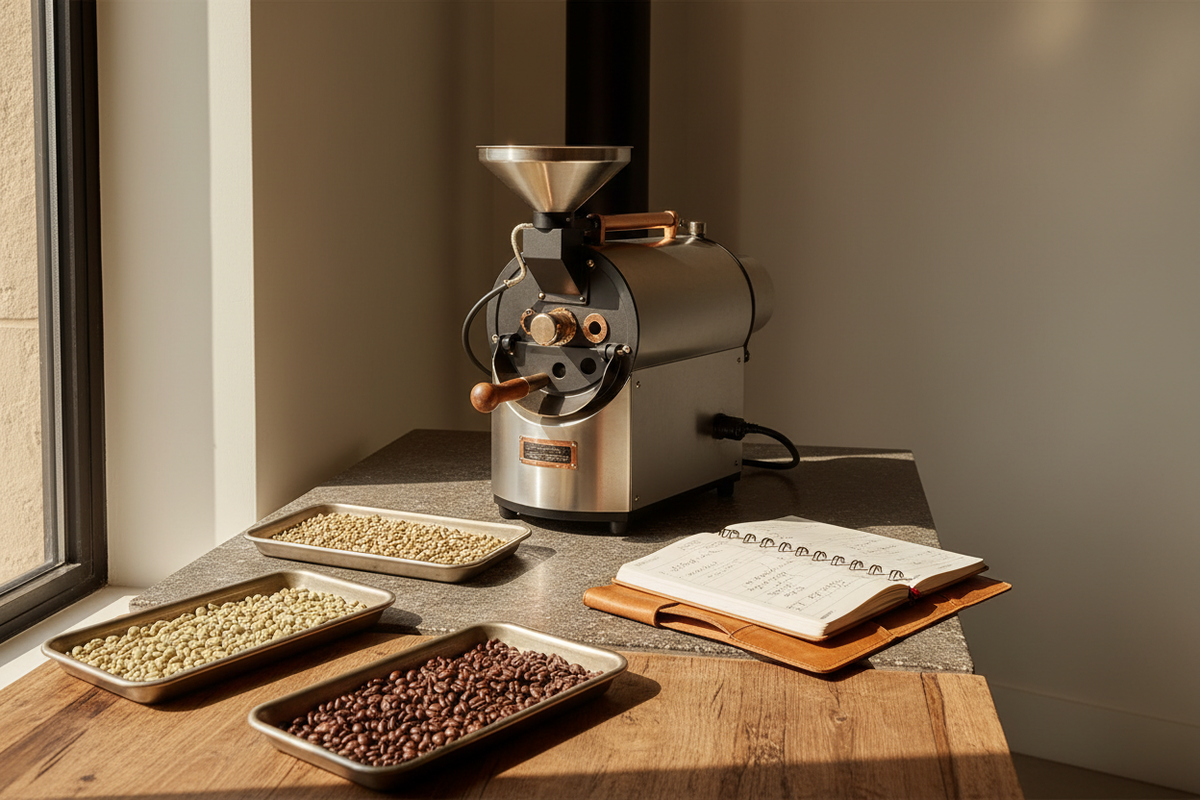
Small-batch roasting involves roasting much smaller quantities — typically 5 to 25 pounds per batch — in smaller drum roasters. This gives the roaster precise control over every variable: temperature curves, airflow, drum speed, development time. And because batches are small, the coffee is roasted to order or in very small quantities, meaning it reaches you days — not months — after roasting.
Why Batch Size Matters
1. Heat Distribution and Consistency
In a large commercial roaster, beans at the center of a massive batch experience different heat than beans at the edges. This uneven heat distribution leads to inconsistent roasting — some beans are slightly over-developed, others under-developed, all in the same batch.
In a small-batch roaster, every bean in the drum experiences the same heat profile. The result is a more evenly roasted, more consistent cup — where every sip tastes like the roaster intended.
2. Roaster Attention and Craft
When you're roasting 5 pounds instead of 500, you can pay attention to every batch. Small-batch roasters monitor the roast in real time — watching the color change, listening for the audible "crack" that signals key development stages, adjusting temperature curves on the fly based on how a specific lot of beans is responding.
This level of attention is impossible at industrial scale. It's the difference between a chef cooking for 10 and a factory producing 10,000 meals.
3. Freshness — The Most Important Factor
Coffee is at its peak flavor within 7–21 days of roasting. After that, oxidation begins to degrade the aromatic compounds that make specialty coffee taste the way it does. Stale coffee isn't just less flavorful — it's a fundamentally different (and worse) product.
Large commercial roasters ship coffee that may sit in a warehouse for weeks, then on a store shelf for months. By the time it reaches your cup, it could be 3–6 months post-roast.
Small-batch roasters — especially those who roast to order — ship coffee within days of roasting. The difference in your cup is not subtle. It's dramatic.
4. Origin Integrity
Single-origin specialty coffee is grown to express the unique character of a specific place — the soil, altitude, climate, and processing method of a particular farm or region. That character is fragile. It can be destroyed by over-roasting, under-roasting, or stale beans.
Small-batch roasters typically source directly from farms or importers who specialize in traceable, high-quality green coffee. They roast each origin to a profile specifically designed to highlight its unique character — not to produce a generic "medium roast" flavor that works for everything.
What Small-Batch Roasting Is Not
It's worth being clear: small-batch roasting is not automatically better just because it's small. A poorly executed small-batch roast is worse than a well-executed large-batch roast. The batch size creates the conditions for quality — the roaster's skill and sourcing determine whether those conditions are realized.
This is why sourcing matters as much as roasting. The best small-batch roasters start with exceptional green coffee — traceable, high-scoring, carefully processed beans from farms that prioritize quality over yield. Without great raw material, even the most skilled roaster can't produce a great cup.
How We Roast at Cozy Notes
Every coffee in our lineup is roasted to order in small batches. When you place an order, your beans haven't been roasted yet. We roast them specifically for your order and ship within days — so you receive coffee at peak freshness, every time.
We source each origin from farms and importers who share our commitment to quality and traceability. Our Ethiopia Natural comes from sun-dried raised-bed farms. Our Kenya AA is double-fermented before drying. Our Sumatra is wet-hulled using the traditional Giling Basah method. Every origin has a story, and every roast profile is designed to tell it.
The result is coffee that tastes the way the farmer and the roaster intended — not the way a warehouse and a shelf allowed.
How to Tell If Your Coffee Is Fresh
Look for these indicators when buying any coffee:
- Roast date on the bag — not a "best by" date. A roast date tells you exactly when the beans were roasted. Aim for coffee roasted within the last 2–3 weeks.
- One-way valve on the bag — this allows CO2 (released by freshly roasted beans) to escape without letting oxygen in. It's a sign the roaster cares about freshness.
- Bloom when brewing — fresh coffee releases CO2 when hot water hits it, creating a "bloom" or bubble. If your coffee doesn't bloom, it's stale.
- Aroma — fresh coffee smells intensely of its tasting notes. Stale coffee smells flat, papery, or like nothing at all.
The Bottom Line
Small-batch roasting matters because freshness matters, consistency matters, and craft matters. It's the difference between coffee that's a commodity and coffee that's an experience.
Every bag we ship is roasted to order, packed fresh, and delivered to your door at peak flavor. That's not a marketing promise — it's the only way we know how to do it.
Ready to taste the difference? Browse our Single Origin Collection — every origin roasted to order, shipped fresh.
Or if you're not sure where to start, our Coffee Sample Packs are the best way to explore multiple origins and roast profiles in one order.