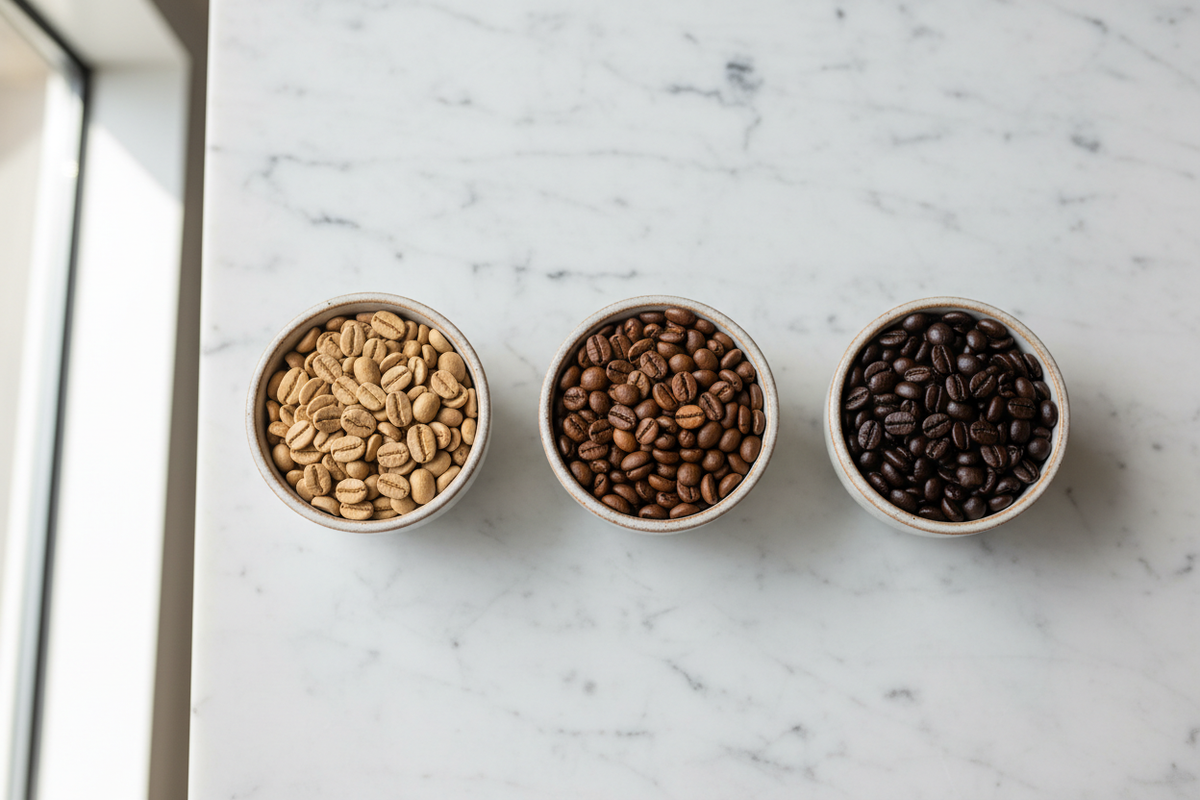
Light vs Medium vs Dark Roast: Which Coffee Is Right for You?
Will TorresShare
Walk into any coffee shop and you'll see the same three words on the menu: light, medium, dark. Most places treat them like a volume dial — light is mild, dark is strong. That's not how roasting actually works, and it's one of the reasons so many people end up drinking coffee they don't actually enjoy.
Here's the real story — and how to find the roast that fits your cup.
What Roasting Actually Does
Roasting applies heat to a green coffee bean to develop its flavor. The longer and hotter the roast, the more the bean's original character gets replaced by roast character — the smoky, bitter, caramelized notes most people associate with "strong" coffee.
Here's the counterintuitive part: darker roast does not mean more caffeine. Lighter roasts actually retain slightly more caffeine because the roasting process breaks it down over time. Dark roast tastes stronger because of bitterness — not caffeine content.
Light Roast: The Origin Speaks
Light roasts are roasted to around 356–401°F, stopping before the first crack fully develops. The bean keeps most of its original character — the origin flavors that came from the soil, the altitude, and the processing method.
Flavor profile: Bright, fruity, floral, tea-like, complex
Acidity: Higher
Body: Lighter
Best for: Pour over, AeroPress, cold brew
Light roast is where single-origin coffee shines brightest. If you want to taste the difference between an Ethiopian Sidama and a bright African washed coffee, drink them light. The terroir is front and center.
Try it: Ethiopia Natural (Sidama Zone) — milk chocolate, fruity, caramel — or our African Espresso Blend — bright dark fruit, blackcurrant, and floral notes from Kenya, Tanzania & Ethiopia.
Medium Roast: The Sweet Spot

Medium roasts hit around 410–428°F, past the first crack but before the second. The bean's origin flavors are still present, but the roast adds sweetness and body that makes it more approachable for most palates. The result is a balanced profile — neither too bright nor too heavy.
Flavor profile: Balanced, sweet, chocolatey, nutty, smooth
Acidity: Moderate
Body: Medium
Best for: Drip, French press, pour over, espresso
Medium roast is the most versatile — it works across almost every brewing method and appeals to the widest range of tastes. It's also where most of our single-origin lineup lives.
Try it: Colombia (Medellín, Antioquia) — dried orange, berry, chocolate — or Costa Rica (Alajuela) — sweet apple, raisin, honey.
Medium-Dark Roast: Bold Without Burning
Medium-dark roasts reach 437–446°F, into the second crack. Origin flavors start to fade, replaced by deeper roast character — dark chocolate, molasses, brown sugar, earthiness. The body gets heavier and acidity drops significantly. This is where you get a truly full bodied cup.
Flavor profile: Rich, bold, dark chocolate, earthy, low acidity
Acidity: Low
Body: Full
Best for: Espresso, French press, moka pot
This is the roast for people who want a serious, grounding cup — something that holds up to milk or stands alone as a bold black coffee.
Try it: Bali Blue (Kintamani, Indonesia) — dark chocolate, molasses, brown sugar — or our Sumatra (Aceh, Takengon) — syrupy body, dark chocolate, dried fruit.
What's the Difference Between Dark Roast and Medium?
The difference between dark roast and medium comes down to three things: flavor, body, and acidity. Medium roast preserves more origin flavors and has a balanced profile with moderate acidity. Dark roast — and medium-dark — trades those nuances for a bolder, full bodied cup with lower acidity and deeper roast-driven notes like dark chocolate and molasses. Neither is better — it depends entirely on what you want in your cup.
The Cozy Notes Difference
Most roasters pick a roast level and apply it uniformly across their catalog. We don't. Every origin we carry is roasted to the level that best expresses that specific bean — its density, its moisture content, its altitude of origin.
That's why our Ethiopia is a light-medium and our Bali Blue is a medium-dark. Not because of a formula — because that's what each bean needs to taste its best.
No artificial flavors. No shelf-sitting. Roasted to order, shipped fresh.